

Podcast Transcripts for AEO: Turning Audio Into a Citable Asset
Audio is invisible to AI engines without a transcript. Here is how to turn podcast episodes into AEO citation surfaces with the right structure and schema.
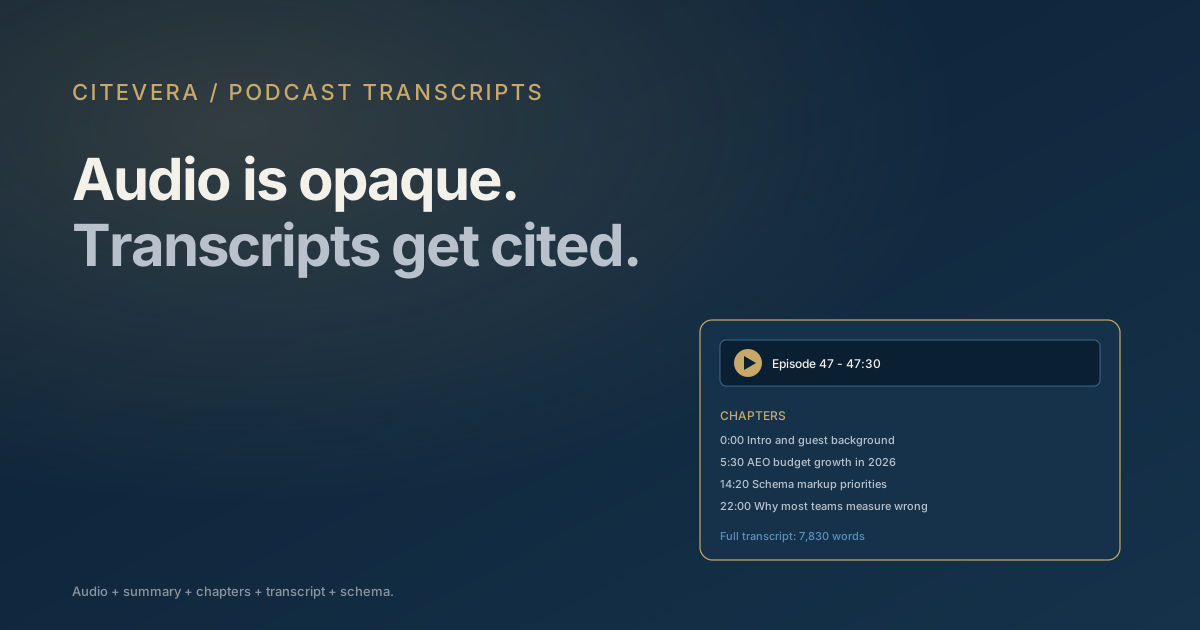
A podcast that lives only as audio and on Apple Podcasts contributes almost nothing to AEO. AI engines do not crawl audio. They do not index podcast catalogs. The only path from podcast to citation runs through a published transcript on your domain. Yet most B2B podcasts publish episode notes with three bullet points and no transcript, leaving 30 to 60 minutes of substantive content unciteable.
This post covers the transcript-and-page pattern that turns a podcast into an AEO asset, the editing investment that pays back, and the schema that completes the picture.
Why podcasts are an AEO blind spot
Three structural reasons:
1. Audio is opaque to retrieval pipelines. Until multimodal podcast indexing matures, transcripts are the only path to citation. 2. Episode notes are typically too thin. A 200-word summary of a 45-minute conversation is not a citation surface. 3. Hosting platforms do not propagate to your domain. Apple Podcasts, Spotify, and YouTube earn their own discoverability; your domain earns nothing unless you publish.
The opportunity: a 45-minute interview with a domain expert is one of the densest pieces of content you can produce per editorial hour. With a transcript, that content becomes 6,000 to 10,000 words of citable expert dialogue. Without one, it is invisible.
The transcript options compared
Three tiers, similar to video transcripts:
Auto-generated only, hosted on a third-party site
Platforms like Descript, Otter, and Rev offer auto-generated transcripts at the time of upload. If you only host these on the platform's domain, your site gets nothing. This is the worst option for AEO.
Auto-generated, embedded on your episode page
A meaningful improvement. The text is now retrievable on your domain. Quality is uneven on names, jargon, and acronyms. Acceptable for high-volume podcasts where edit cost is prohibitive.
Edited transcript with timestamps and speaker labels
The strongest option. An editor cleans up auto-generated transcripts, adds speaker labels, fixes jargon, and timestamps every 1 to 2 minutes. Cost: $50 to $120 per 60-minute episode at typical editor rates. For a podcast that earns substantial citations, this is the right tier.
For most B2B podcasts, the right strategy is a hybrid: auto-generated for current episodes, edited for evergreen flagship interviews. Roll back through the catalog as budget allows.
The episode page structure that earns citations
A strong podcast episode page has eight elements:
Page title with episode number and topic
> "Episode 47: How AEO is changing B2B SaaS marketing budgets - with Sara Chen"
Specific. Includes the guest name. Avoids generic titles.
Audio player at the top
Standard embed from your hosting platform. Allows immediate listening.
Subscribe links
Apple Podcasts, Spotify, YouTube, Amazon Music. These do not contribute to AEO directly but they capture human listeners.
A 100 to 200 word episode summary
The summary is a citation candidate in its own right. Treat it like a definition paragraph: name the guest, name the topic, surface 3 to 4 substantive subtopics covered. No fluff.
A "key takeaways" section
5 to 8 bullet points capturing the central claims from the episode. These are highly extractable: short, self-contained, fact-dense. Models cite "key takeaways" lists frequently.
A timestamped chapter list
> 0:00 - Introduction and guest background > 5:30 - How AEO budgets are growing in 2026 > 14:20 - The role of schema markup > 22:00 - Why most teams measure AEO wrong
Timestamps with descriptive titles. Each chapter title is a mini-headline that the model can use when citing specific moments.
The full transcript
Not behind an accordion. Not behind a "click to expand". Plain HTML below the chapter list. Speakers labeled. Timestamps every 1 to 2 minutes.
A "related episodes" footer
3 to 5 links to other episodes on adjacent topics. Topic-cluster signal.
Schema markup for podcast episodes
Two schema types work together:
PodcastEpisode
{
  "@context": "https://schema.org",
  "@type": "PodcastEpisode",
  "name": "How AEO is changing B2B SaaS marketing budgets",
  "url": "https://acme.example/podcast/episode-47/",
  "datePublished": "2026-05-20T08:00:00-07:00",
  "duration": "PT47M30S",
  "associatedMedia": {
    "@type": "MediaObject",
    "contentUrl": "https://cdn.acme.example/podcast/47.mp3"
  },
  "partOfSeries": {
    "@type": "PodcastSeries",
    "name": "Acme Cloud Podcast",
    "url": "https://acme.example/podcast/"
  }
}
Article schema for the page itself
The episode page is also an article. Article schema with transcript referencing the transcript content reinforces the page's citation surface.
A combined block where the PodcastEpisode is the central entity and the Article wraps the page works well.
The editing investment for evergreen episodes
If you have 50 episodes and limited budget, the prioritization for transcript editing:
1. Top 10 most-listened episodes. Highest leverage; existing audience signal that the topic resonates. 2. Interviews with named domain experts. Expert quotes are AEO citation fuel. 3. Topical-pillar episodes. Episodes that align with your content cluster strategy. 4. Recent episodes with strong listen-through. Newer content compounds faster. 5. Older episodes in editing rotation as budget allows.
For new episodes, build the editing cost into the production budget so it is not retroactive cleanup.
Repurposing transcripts into other content
A clean transcript is the input to multiple downstream assets:
- Blog post summary. A 1,000 to 1,500 word post pulled from the most substantive 20% of the transcript. Cite the episode and link.
- Quote graphics. Pull citable lines for LinkedIn and X.
- FAQ entries. Questions the host asked become FAQ candidates with the guest's answer.
- Glossary entries. Terms the guest defines become glossary entries with the guest's explanation.
A single edited transcript can produce 4 to 6 derivative AEO assets. The unit economics improve dramatically when you plan the repurposing during episode production rather than as an afterthought.
Common podcast page mistakes
Five recurring failures:
- Transcript behind a paywall or login. AI crawlers cannot reach gated content.
- Transcript on a different page from the audio. The episode page should have everything together.
- Transcript loaded via JS after page render. AI crawlers without JS execution miss it. Server-render the transcript.
- Audio-only embed with iframe to Spotify/Apple. Provide the audio embed but supplement with the transcript and chapters on your domain.
- Episode pages with no internal linking. Each episode should link to 3 to 5 related episodes plus 2 to 3 relevant blog posts and glossary entries.
Measuring podcast AEO performance
Three metrics worth tracking:
- Indexed transcript pages in Google Search Console (proxy for AI crawler access).
- Referrer traffic from AI engines to podcast episode URLs.
- Citations of episode content in manual query tests where you ask AI engines about topics covered in your podcast and watch for guest names or your podcast name in the response.
The third metric is the most direct AEO signal. Set up a quarterly query test for your top 20 podcast topics and watch the trend.
Key takeaways
- A podcast without a published transcript on your domain contributes nothing to AEO.
- The episode page should include audio, summary, key takeaways, timestamped chapters, full transcript, and related episodes.
- PodcastEpisode + Article schema together provide the structured-data backbone.
- Edited transcripts ($50 to $120 per episode) are worth the investment for flagship interviews.
- Repurpose transcripts into blog posts, FAQ entries, and glossary entries to multiply the AEO output.
What to do next
Run a free audit at scan.citevera.com to see whether your podcast pages publish transcripts that AI crawlers can read. The report flags missing transcripts as a high-impact AEO gap on your domain.
For the related question on video, VideoObject schema for AEO citations covers the same pattern adapted to video content.