

Local AEO: How Service Businesses Get Cited in Geo-Specific AI Answers
Local service businesses face a different AEO challenge than national brands. Here is what changes when geography is the binding constraint, and the local-specific signals that drive citation.
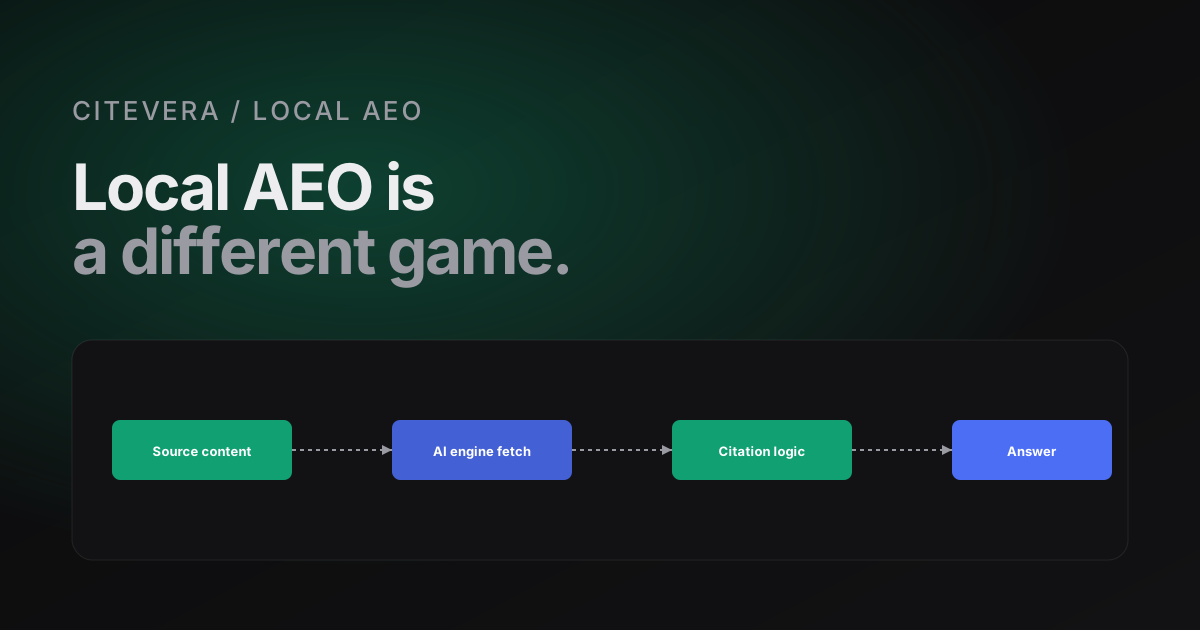
The binding constraint of local
National brands compete on quality of content and structural readiness. Local service businesses compete on the same axes, but with geography as a binding constraint that nationals do not face.
A buyer asking "best plumber near me in Cincinnati" gets a different answer than a buyer asking "best plumbing CRM software." The first answer is constrained to plumbers operating in Cincinnati. The second is open to any vendor in the world. Local AEO operates in the constrained space.
This changes what works. National AEO advice about thought leadership, original research, and broad topical coverage matters less. Local AEO emphasizes proximity, NAP consistency, review density, and local-context signals.
What AI engines look for in local queries
Five signals consistently drive local AI citation.
LocalBusiness schema with full address and service area. The most important local-specific signal. Google has been training engines on LocalBusiness schema for years; Anthropic and OpenAI followed. A service business without LocalBusiness schema is structurally invisible for local queries.
NAP consistency across the web. Name, Address, Phone identical on your site, Google Business Profile, Yelp, BBB, industry directories, and any other listings. Inconsistencies confuse engines and lower citation rates.
Review presence and density. Engines weight review signals heavily for local queries. A business with 200 verified reviews on Google cites more reliably than one with 12 reviews, even controlling for other factors.
Service area pages. Pages targeting specific neighborhoods, cities, or regions where you operate. These cite for geo-specific queries the way category pages cite for topical queries.
Citation density on local directories. Listings on industry-relevant directories (Yelp, Angi, BBB, vertical directories like Avvo for legal). The density of these listings is a structural authority signal.
Service area pages: the local equivalent of topical clusters
Where a national brand builds topical clusters around content topics, a local service business builds geo clusters around service areas.
A plumbing business in Cincinnati might have:
- /plumbing-cincinnati
- /plumbing-norwood
- /plumbing-blue-ash
- /plumbing-hyde-park
Each page targets a specific neighborhood. Each is built with local-specific content (landmarks, common housing types, local water-utility quirks), not just template substitution. Engines penalize obvious template content; reward genuinely localized pages.
The cluster effect compounds across geo: a business with 12 well-built service-area pages cites more reliably across all of them than the same business with one generic city-level page.
NAP and the consistency tax
NAP consistency sounds trivial. It is operationally hard. The same business often has:
- 3-4 variations of address (street vs. road, suite vs. ste, with or without unit number)
- 2-3 phone numbers (main, after-hours, marketing tracking)
- Slightly different business names (LLC vs. Inc., DBA variations)
Each variation across the web slightly reduces engine confidence. Aggregate variation across 50+ listings produces meaningful citation drag.
The fix is operational: pick the canonical NAP, audit every listing, file corrections systematically. Tools like Yext and BrightLocal automate large portions of this. For small businesses, manual cleanup over a quarter is workable.
Reviews as a structural signal
Engines increasingly weight review evidence. The signals that matter most:
Review count. A threshold effect: businesses with 50+ reviews cite at meaningfully higher rates than businesses with under 50. Above 200, returns flatten.
Review recency. Recent reviews count more than old ones. A business with 200 reviews from 2019 cites worse than a business with 80 reviews from the last 12 months.
Review platform diversity. Reviews on Google, Yelp, Facebook, and industry-specific platforms (Avvo, HomeAdvisor) signal broader presence than 200 reviews on Google alone.
Review response patterns. Businesses that respond to reviews (especially negative ones) signal active engagement, which engines reward indirectly through brand trust signals.
The right cadence: aim for 5-15 new reviews per month with active platform presence and consistent response. Faking reviews is a fast track to penalties.
How Citevera scores this for local businesses
The audit detects local service businesses by LocalBusiness schema and address content, then applies local-specific weights. NAP consistency, service-area page coverage, review presence, and local directory citations are weighted more heavily than for national brands.
The audit checks NAP consistency across major directories, identifies missing or weak service-area pages, and flags review-density gaps. The recommendations are local-specific: "build 3 more service-area pages for these neighborhoods you operate in," "fix the address inconsistency on Yelp," "your review velocity dropped 40% in the last 90 days."
Run a free Citevera audit calibrated for local service businesses
Frequently asked questions
Do AI engines factor in physical proximity to the searcher?
Indirectly. Engines respect geo intent in the query (city names, "near me" phrases) and pull from sources that match the geo. They do not have direct GPS-style proximity to the searcher; they rely on geo signals embedded in the content and listings.
Should I have separate pages for each neighborhood I serve?
Yes if you genuinely serve them with different content. Template pages with city-name swaps cite poorly. Real differentiation - local landmarks, common needs, neighborhood-specific service notes - cites well. If you cannot say something genuinely different about each neighborhood, do not create the page.
How important is Google Business Profile?
Critical. Most AI engines pull local business data through Google's ecosystem. A complete, accurate, recently-updated GBP listing is foundational for local AEO. Missing or stale GBP data is a citation blocker.
Do bigger national brands beat small local ones in local queries?
Not consistently. Local AEO rewards proximity and local-context signals over brand size. A small plumber with strong LocalBusiness schema, 200 local reviews, and 8 service-area pages will outcite a national brand with weaker local signals on geo-specific queries.
How do I track local citations across cities?
Track per-city prompts in your monitoring program. Citevera Monitoring supports geo-specific prompt sets so you can see which cities you cite well in and which need investment. Track per-city, per-engine, weekly. Trends emerge over a quarter.
How does AEO interact with Google Business Profile reviews?
GBP reviews feed both Google AI Overviews and the broader AI ecosystem indirectly. Engines pull aggregate review data, sentiment, and review themes when synthesizing local recommendations. Maintaining GBP review velocity (5-15 new reviews per month) and responding to reviews are foundational local AEO practices.
What is the right number of service-area pages for a small local business?
5-12 for a service business operating in one metro area. One per neighborhood you genuinely serve, with neighborhood-specific content (landmarks, common housing types, local conditions). More than 12 thin pages hurts more than helps; engines penalize obvious template content.
Do AI engines weight Google Business Profile categories?
Yes, indirectly through Google's ecosystem and directly through their own training data. Choose primary and secondary categories that match how buyers actually describe your service. A plumber primary + emergency-service-related secondary categories produce better citation alignment than generic 'home services' alone.
How do AI engines handle service businesses with multiple physical locations?
Each location should have its own LocalBusiness schema with distinct address and service-area fields, ideally on its own location page. A multi-location business with one generic "locations" page underperforms a multi-location business with dedicated pages per location. The per-location pages cite for geo-specific queries that would otherwise miss the brand entirely.
What is the typical timeline for local AEO results?
Three to six months for measurable lift in service-area-specific citations once the foundation (LocalBusiness schema, NAP consistency, service-area pages) is in place. Local AEO moves faster than national AEO partly because the competitive set per geo is smaller and review velocity has more direct effect.