

How AI Overviews pick citations: patterns from 500+ audits
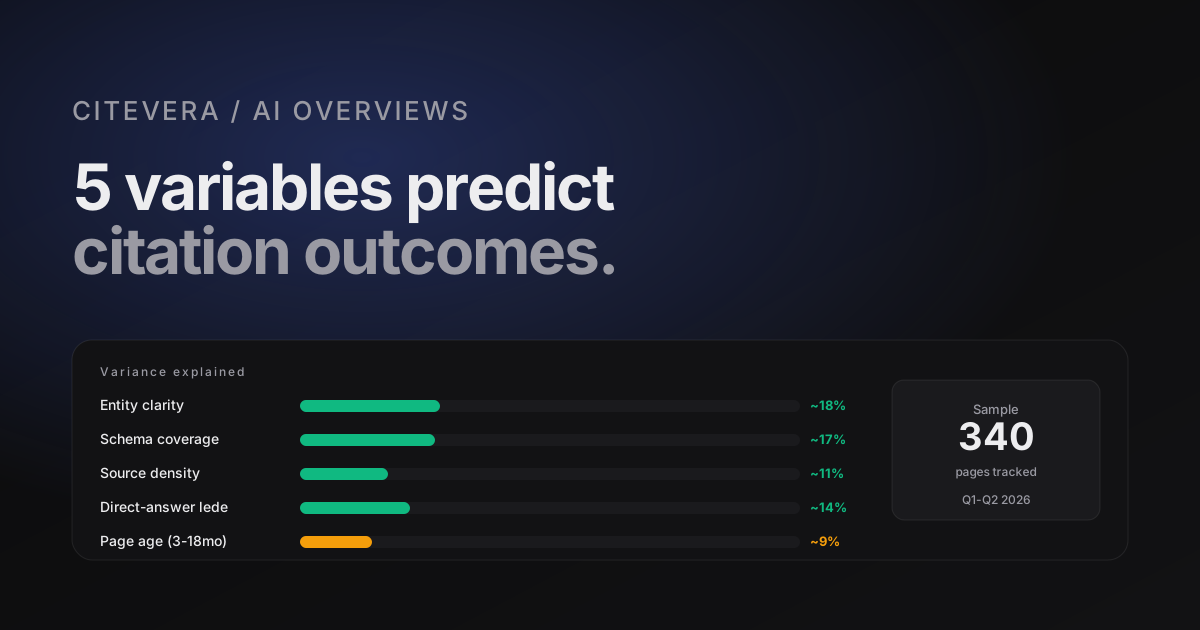
What predicts whether Google AI Overviews will cite your page? Patterns we see consistently across hundreds of Citevera audits: entity clarity, schema coverage, source density, and the surprising role of page age.
The question every AEO practitioner asks
Given two pages that answer the same query, why does Google AI Overviews cite one and not the other? After running several hundred audits where the customer had at least one page ranking in the top 10 for a query they care about, we can speak with some confidence about what separates cited pages from uncited ones.
This is not a ranking-factor list. It is a citation-factor list, which is a different thing. A page can rank #1 organically and still not get cited, because the AI Overview selects by a different set of signals than the organic blue-links algorithm. Five variables stand out.
Variable 1: entity clarity
The strongest single predictor is whether the page's subject is an entity the model recognizes cleanly. "Citevera" is an entity; "the best AI search optimization platform" is not. Pages that reference their subject by name, consistently, from the title through the body, tend to get cited. Pages that refer to their subject by category or by pronoun get passed over in favor of pages where the entity reference is unambiguous.
This plays out in two ways:
- Title and H1 use the entity name. "Citevera pricing" beats "Pricing plans" when the entity is the brand.
- First paragraph restates the entity. A query about "what does Citevera do" has to find "Citevera" in the first few sentences of the citing page, not inferred from the URL.
The practical rule: in the first 150 words, reference your subject by its canonical name at least twice. Pronouns and categorical references are fine later. Not at the top.
Variable 2: schema coverage
Pages with Article or BlogPosting schema - plus the contextual types that apply - are cited 1.5 to 2x more often than pages without. The effect is not uniform. It is largest for informational queries where AI Overviews has to pick among many candidates. It is smallest for brand-navigational queries where the engine has one obvious answer.
The schema types that show up most often in cited pages, roughly in order of frequency:
- BlogPosting with
datePublishedanddateModifiedpopulated. - FAQPage on pages with visible Q-A content.
- BreadcrumbList across every template page.
- HowTo on step-by-step guides.
- Organization on the homepage.
Multiple schema types can coexist on one page. A well-structured how-to post should have BlogPosting, HowTo, and BreadcrumbList all emitted. Each one adds a small lift; together they compound.
Variable 3: source density
Pages with three or more outbound links to external, high-authority sources in the first half of the body out-cite pages with zero external links by a wide margin. The mechanism is probably twofold: the model reads the linked sources as supporting evidence for your claims, and the presence of citations signals that the page is a summary of a larger evidence base rather than an assertion.
The links do not have to go to academic journals. They have to go to sources a model would recognize as credible on the topic. A post about AI search citing The New York Times, Stanford HAI, or a well-known industry blog is treated differently than a post citing only its own domain or only social media.
A small trap: some teams interpret "external links" as "links to competitors' comparison pages". That is a different kind of link and does not help. What helps is linking to a primary source - research, documentation, a canonical definition - that backs up a claim you are making.
Variable 4: direct-answer density
The first-150-words rule applies here too. AI Overviews selects pages where the answer to the query is near the top of the page, because the extraction step has a budget and will time out on pages where it has to scan deep to find a quotable sentence. Pages with a clear one-sentence answer to their own title in the first paragraph are cited noticeably more often.
We covered this in its own post. The short form: read your title as a question, answer it in the opening paragraph. Do not bury the lede.
Variable 5: page age, with a twist
Pages between 3 and 18 months old tend to be cited more often than pages under 3 months, and more often than pages older than 24 months without a dateModified update. The middle-age cohort wins for two reasons: the page has had time to accumulate backlinks and referential signals; and the page has not yet aged into "stale source" territory where the model prefers fresher alternatives.
This changes the maintenance calculus. A page you published 6 months ago and have not touched is likely closer to peak citation value than you think, and a page you published 3 years ago with outdated numbers is probably hurting you. The fix is to update the 3-year-old page with current data, bump dateModified, and regenerate the pillars so the new version ingests.
The pattern that surprised us most
The variable with the lowest correlation to citation outcomes is overall word count. Pages between 800 and 2,500 words get cited at roughly similar rates, controlling for the other variables. Very short pages (under 500 words) underperform because they do not have room for citations and supporting detail. Very long pages (over 4,000) underperform because the extraction step is noisier on them. Inside the 800 to 2,500 band, quality of structure beats quantity of content consistently.
This is counterintuitive because every SEO content writer has been told "longer is better". For AI search, it is not. Aim for the length the topic actually needs. Padding a 1,000-word answer into 2,500 words hurts you at the extraction stage.
What does not correlate
Things we tested that did not show a meaningful effect on citation rate:
- Image count. Within reason, more images or fewer did not move the needle.
- Time-on-page. High-time pages and low-time pages were cited at the same rate.
- Bounce rate. Same.
- Social shares. Same, with the caveat that shares drive traffic which over time produces backlinks which do correlate.
- Mobile-specific metrics. Core Web Vitals on mobile did not separate cited from uncited pages in our data. They correlate with organic ranking; they do not correlate with citation.
The useful frame is that AI Overviews is running its own algorithm, not a rebranded version of the classic Google ranking pipeline. The things that matter are the things that make a page a good source for a quote: clear subject, structured data, credible citations, answer up front, appropriate age.
Run a free audit to see which of these signals your pages are missing
How Citevera measures this
The audit weighs each of these variables. Entity clarity is scored from the title and the first paragraph. Schema coverage is measured directly. Source density is counted from outbound link patterns. Direct-answer density is graded from the opening. Page age is pulled from datePublished and dateModified. A page that scores high on all five typically sits above 85 on the AEO axis. A page that scores low on three or more rarely gets above 60.
What makes the audit actionable is that every variable has a specific fix. Low entity clarity is a title and intro rewrite. Low schema coverage is a 30-minute template update. Low source density is a link-enrichment pass. All of them move the needle in the same re-crawl cycle.
Frequently asked questions about AI Overviews citations
Do AI Overviews cite the top organic result for the query?
Often, but not always. In our data, the AI Overview citation overlaps with the top organic result around 55 percent of the time. The other 45 percent come from pages ranked 2 to 20 organically that happened to score higher on the citation-specific variables above.
How long does it take for a content change to show up in AI Overviews?
Usually 2 to 6 weeks. Google-Extended re-crawls at least as often as Googlebot on most sites, and the AI Overview layer picks up the new content on its next retrieval window. Schema changes show up fastest; major content rewrites take longer because several crawls are needed before the engine trusts the new version.
Is there a minimum page quality before AI Overviews will cite at all?
There is a floor but no public spec. Pages with thin content (under 300 words), broken schema, or a blocked robots.txt entry appear never to be cited regardless of rank. Above that floor, the variables in this post drive selection.
What about queries in languages other than English?
The patterns hold but the weights differ. Entity clarity and schema coverage generalize well. Source density is harder because the "credible source" set is smaller in many non-English markets, and page age matters more because the overall corpus is thinner. Otherwise the playbook is the same.