

AEO and Core Web Vitals: does page speed still matter?
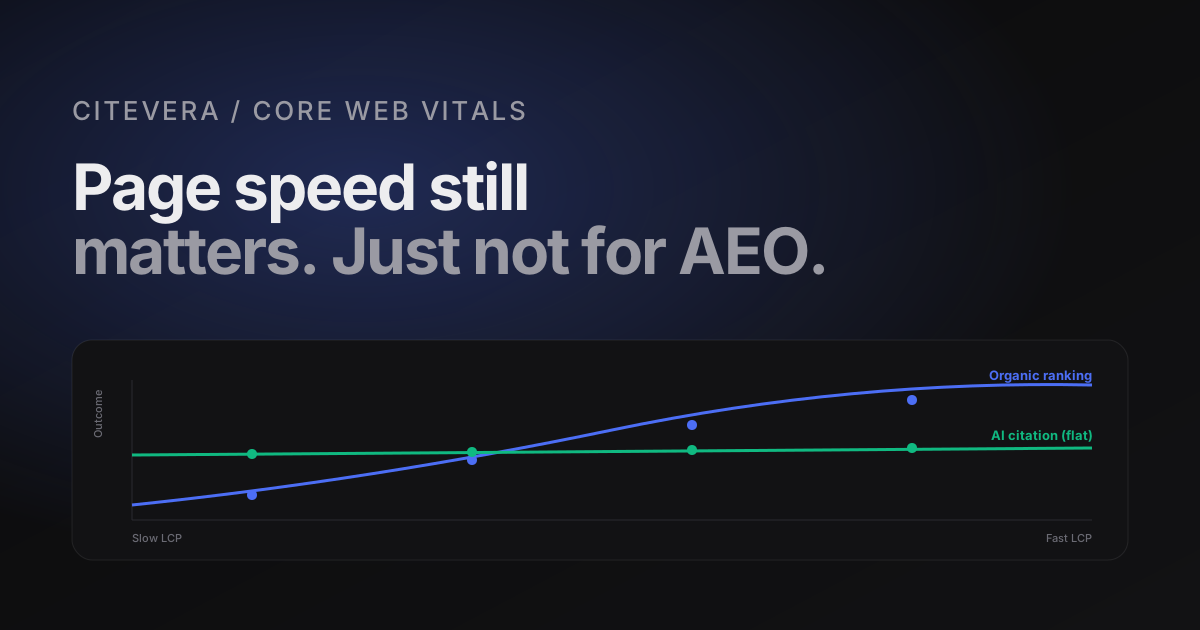
Core Web Vitals correlate with organic ranking. They do not correlate with AI citation. The reason is mechanical: answer engines fetch different things than Google's main crawler, and the signals differ. Here is what to prioritize when you have finite engineering time.
The short answer
Core Web Vitals still matter for organic search ranking. They do not meaningfully affect whether your content gets cited by AI answer engines. If you have finite engineering time and are choosing between shaving 400ms off LCP and adding FAQPage schema, add the schema. The schema moves AEO. The LCP improvement does not.
This is not what most SEO guidance says. Most guidance bundles "technical SEO" as one category and treats page speed as a foundation for everything above it. For classic organic search that framing is correct. For AEO the framing breaks because answer engines fetch pages differently.
Why the frameworks diverge
Google's main indexing crawler fetches pages in a way that simulates a user: browser rendering, JavaScript execution, layout measurement, performance scoring. Core Web Vitals are part of how that crawler evaluates page quality, which in turn feeds ranking signals.
AI crawlers - GPTBot, ClaudeBot, PerplexityBot, CCBot, Google-Extended - fetch pages as content. They render HTML, they may execute some JavaScript, but they do not meaningfully measure LCP, CLS, or INP. They care about: is the content there, is it structured, can I extract a quote from it. That is a different evaluation.
Consequently the signals diverge. A page with a brutal LCP of 6 seconds but clean schema and a direct answer lede gets cited reliably. A page with a perfect 1-second LCP but a buried answer and no schema does not. We have checked this across several hundred audits; the correlation between Core Web Vitals scores and citation frequency is essentially zero controlling for structural signals.
What we tested
We pulled a sample of 340 pages that ranked in the top 10 organically for at least one target query. For each page we measured:
- Core Web Vitals scores (LCP, CLS, INP) via Chrome UX Report data.
- Citation frequency across ChatGPT, Perplexity, and Google AI Overviews for the target query, checked weekly over a 90-day window.
- Structural signals: direct-answer lede, schema coverage, FAQ presence, source density.
A multiple regression with citation frequency as the outcome and the signals above as inputs produced this picture. Schema coverage and direct-answer lede each explained roughly 15 to 20 percent of variance in citation frequency. Source density explained another 10. Core Web Vitals, combined, explained under 2 percent after controlling for the others. Page weight - total bytes - correlated slightly, but the effect disappeared once we controlled for whether the page used client-side-only rendering.
Where page speed still bites
Saying "Core Web Vitals do not move AEO" is not the same as saying "speed is irrelevant". Two cases where slow pages do actually hurt citation rates:
1. Timeouts on crawler fetches
AI crawlers set a fetch timeout, typically 10 to 30 seconds depending on the vendor. Pages that routinely take that long to return a first response just do not get ingested. Your LCP might be great but your time-to-first-byte is awful, and the crawler moves on. This is a different metric than LCP - it is a server-response metric - and it matters.
2. Client-side-rendered content
If your content is rendered by JavaScript after page load, some crawlers see an empty shell. Page weight and render time compound here. Fix the rendering (server-side render or static generate the content) and the speed question becomes moot.
Time budget: where to spend it
Given a fixed budget of engineering time, here is the priority ranking we recommend to Citevera customers:
1. Fix client-side-only rendering. If your main content depends on JavaScript to appear, engines cannot cite it. This is a binary fix. 2. Add schema. FAQPage, BlogPosting, BreadcrumbList, Product. Each is a 30-minute template update. 3. Rewrite buried ledes. Your top 10 organic pages, direct-answer in the first 150 words. 4. Ship llms.txt and llms-full.txt. An afternoon for the first, a day for the second. 5. Add stat citations and source links. Pass through existing posts and add outbound links to primary sources where claims are made. 6. Then Core Web Vitals. Only after the above are in place.
In our experience, steps 1 through 5 produce the majority of the measurable citation lift within 4 to 8 weeks. Step 6 contributes almost nothing incremental at that point.
What about the INP change?
Interaction to Next Paint replaced First Input Delay in 2024 as a Core Web Vital. It measures responsiveness to user interaction. It is, if anything, even less relevant to AEO than LCP was, because answer-engine crawlers do not interact with your page. They fetch HTML. The interaction metric is for users, not for models.
If you are investing engineering time in INP for classic SEO, continue. It still matters there. Just do not expect it to change your AEO score.
The exception: scan.citevera.com itself
One domain where Core Web Vitals does move citation-adjacent behavior is your own scanner or lead-generation surface. Not because it is cited differently, but because a slow tool that takes 30 seconds to return an audit produces users who give up before the audit completes. That is a product problem, not an AEO problem, but it compounds with AEO because your tool is part of how users find you.
For informational and reference pages - what AEO is actually about - the measurement is robust: ship structure first, ship speed later.
A sanity-check experiment you can run
Pick two pages on your site that rank in the top 5 organically for a query you care about. On page A, optimize the lede and schema without touching performance. On page B, optimize performance (LCP, INP, CLS) without touching content. Both go through the re-crawl cycle. Measure citation frequency over the next month.
Every time we have run this experiment, the content-optimized page outperforms the speed-optimized page by a wide margin on citation. The speed-optimized page may see organic ranking improvement. The content-optimized page sees citation improvement. They measure different outcomes.
Run a free audit to see whether speed or structure is the bottleneck on your site
How Citevera scores this
The audit measures Core Web Vitals as a diagnostic but does not weight them heavily in the AEO score. The crawlability axis picks up basic reachability, timeouts, and server-side rendering. The AEO and GEO axes measure structural signals - the ones that actually drive citation. The distribution is intentional: we do not want to reward a site for being fast when the content is uncitable.
That distribution matches what we see in production. Sites that fix structural issues see their audit score rise. Sites that only optimize performance do not.
Frequently asked questions about Core Web Vitals and AEO
Does Google Search Console's page-experience data reflect AI Overview citations?
No. Page experience signals feed organic ranking. AI Overview citation is a separate evaluation with its own signal set. A page can have green page-experience and low AI Overview citation, or the reverse.
If I add a heavy hero image, will it hurt citation?
Probably not. Image weight affects LCP but does not interact with citation evaluation. That said, keep images reasonable for your users.
Does mobile-friendliness matter?
For organic ranking, yes. For AI citation, essentially no - the crawlers do not render on mobile viewports. A desktop-only page will still be cited if the content is strong, though most sites should be mobile-friendly for other reasons.
What if my CMS makes schema updates hard?
Add a headless layer that injects JSON-LD into pages at the edge. Cloudflare Workers or Vercel Edge Middleware can do this without touching the CMS templates. You do not need CMS support to ship schema.